
Spine Anatomy (Clinical)
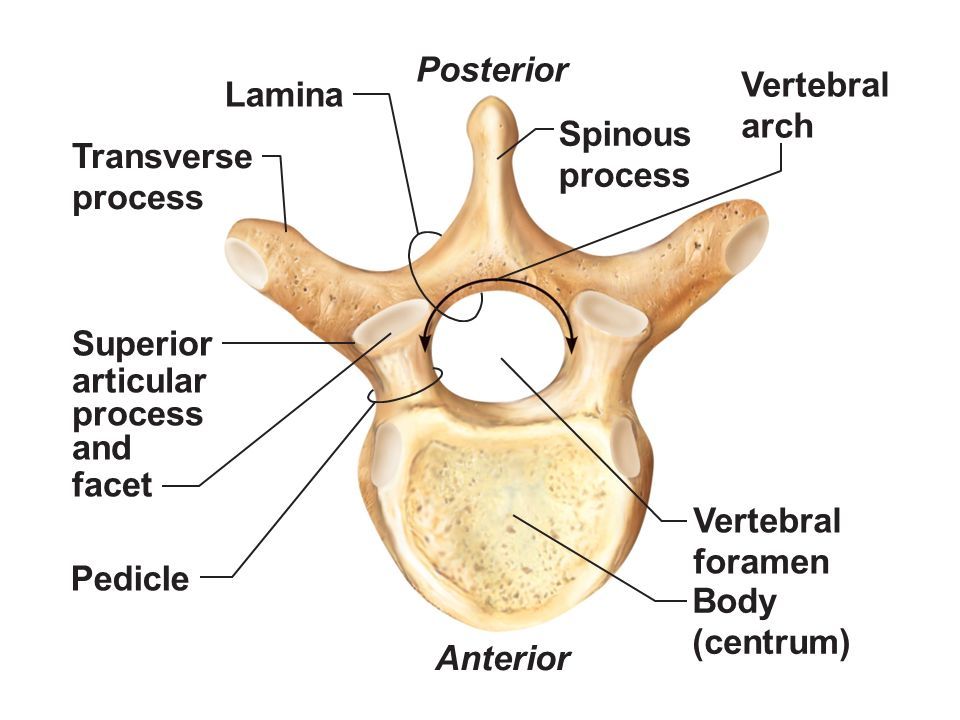
Vertebral Body
The vertebral body sits ANTERIORLY in the body and are the major weight bearing component of the spine, increasing in size from cervical to lumbar. Between each adjacent vertebral body are fibrocartilaginous intervertebral discs. Spinal curvatures are influenced by the shape of both discs and vertebral bodies. Generally in the thoracic spine, where osteoporotic vertebral fractures typically occur, the vertebral body tends to be wedged anteriorly, or having less height in the anterior portion relative to the posterior portion. The shape of the vertebral body as well as the disc contributes to the natural primary curvature (kyphosis) which exists in the thoracic region (see Figure 2). This characteristic is more prevalent in the mid-thoracic region.7
Vertebral Arch
The vertebral arch is comprised of two bony struts and three processes which make up the lateral and posterior aspects of the vertebral column. Directly connected to the vertebral body are two bony pillars on either side, called pedicles. (see Figure 1) Extending posteriorly and medially from each pedicle are two flat sheets of bone called the laminae. The two laminae meet in the midline posteriorly.
Extending laterally and slightly posteriorly at the junction of the pedicle and lamina on either side is a transverse process. The transverse processes provide important bony attachment points for muscles and ligaments and in particular in the thoracic region, for articulation with the ribs. Extending posteriorly and inferiorly, from the junction of the two laminae, is the spinous process. Similar to the transverse processes, this provides an important articulation site for muscles and ligaments.